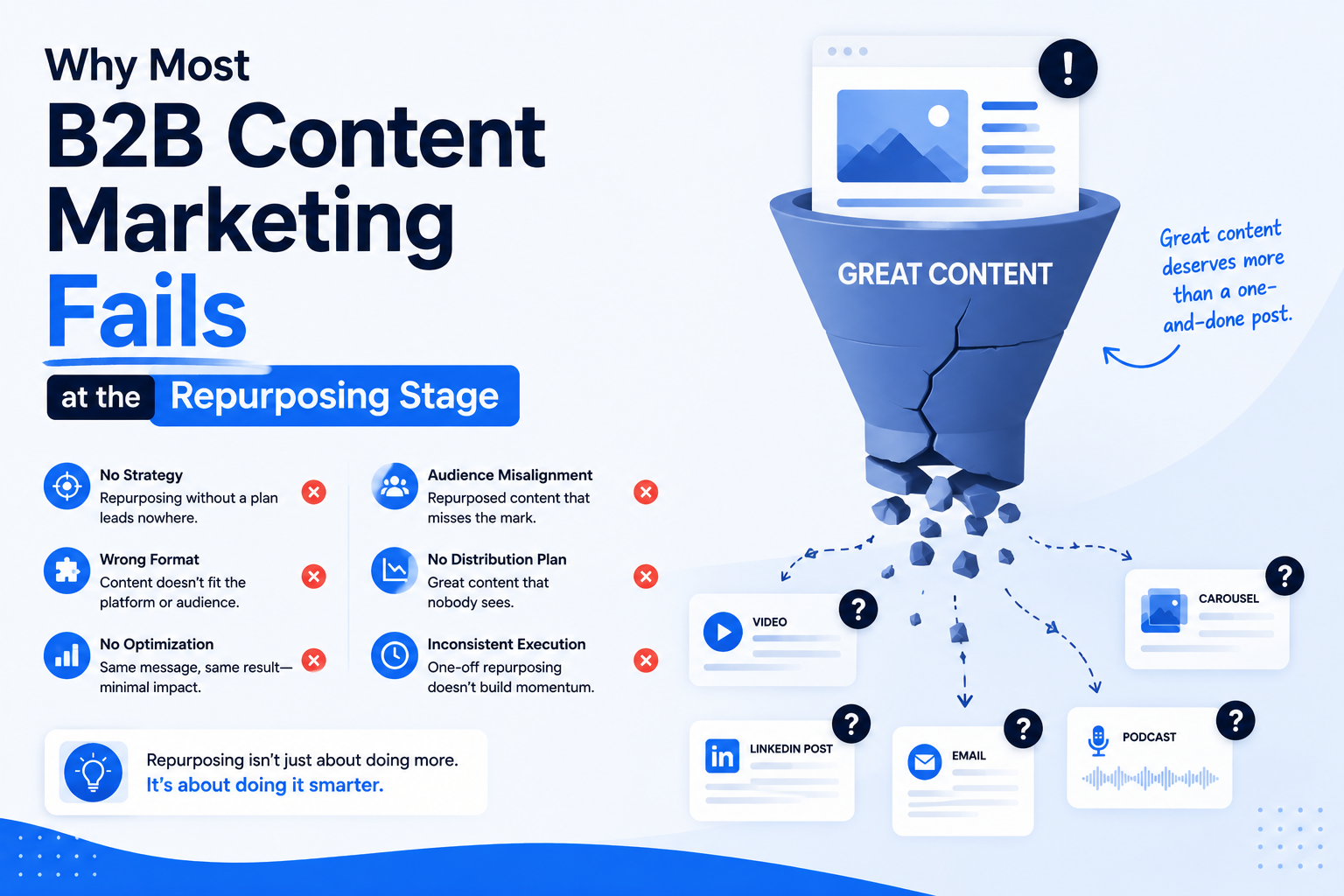
Ask most B2B marketing teams how much content they produce, and the answer is usually impressive: blog posts every week, case studies every quarter, whitepapers, webinars, reports. Ask the same teams how much of that content gets repurposed into other formats, and the answer drops sharply — often to "we mean to, but."
This isn't a content problem. It's a workflow problem, and it shows up at almost the exact same point for nearly every B2B team: the moment between "this content performed well" and "let's turn it into something else."
Here's why that stage breaks down, and what a workflow that actually survives contact with a busy quarter looks like.
The Content Isn't the Bottleneck — The Handoff Is
In most B2B marketing teams, content creation and content repurposing are treated as separate projects, often owned by different people, planned on different timelines, and — critically — competing for the same limited bandwidth.
A blog post gets written, reviewed, and published. That's a complete project with a clear owner and a clear deadline. "Turn that post into a LinkedIn carousel" is a different project, with no inherent deadline, often no clear owner, and — because it depends on the first project finishing — always scheduled after something else that already has more urgency attached to it.
The result is predictable: repurposing becomes the thing that happens "if there's time," and there's rarely time. Not because anyone disagrees it's valuable, but because it's structurally positioned as optional in a way the original content never was.
Repurposing Gets Treated as a Creative Task, Not a Production Task
The second failure point is more subtle. When repurposing does happen, it's often approached the same way the original content was — as a creative project requiring its own ideation, drafting, and design cycle.
But repurposing isn't a creative task in the same sense. The ideas already exist. The research is done. The argument has already been made and refined through editing. What repurposing actually requires is restructuring and reformatting — a production task, not a creative one.
Teams that treat repurposing as "write a new piece of content, but based on an old one" end up doing nearly the same amount of work as creating something from scratch — which is exactly why it keeps losing the bandwidth competition described above. If repurposing takes almost as long as original creation, it will always lose to original creation, which has firmer deadlines and more visible stakeholders.
The Format Gap Nobody Plans For
There's also a skills mismatch that rarely gets discussed directly. The person who writes a strong blog post or report is often not the person equipped to turn it into a LinkedIn carousel or a presentation — those require different skills (visual design, slide structure, platform-specific formatting) that writing doesn't directly transfer.
So even when a team agrees that a piece of content should be repurposed, it often needs to be handed to someone else — a designer, a social media manager — who then needs context on the original content, time to understand what matters most, and their own production time. Each handoff adds delay, and delay is repurposing's biggest enemy: content that performed well two weeks ago is less valuable to repurpose today than it would have been immediately.
What a Repurposing Workflow That Actually Survives Looks Like
The teams that repurpose consistently tend to share a few structural habits — not heroics, just removing the friction points above.
Repurposing decisions happen at publish time, not after performance data comes in. Waiting to see how a piece performs before deciding whether it's worth repurposing sounds efficient, but in practice it just adds another decision point and another delay. Teams that repurpose consistently tend to default to "yes, repurpose this" for any piece that meets a basic bar (clear structure, evergreen topic) — rather than re-evaluating each time.
The same person (or tool) handles the first-draft conversion. Rather than handing off to a different specialist for each format, the most efficient workflows use one step — often AI-assisted — to generate first-draft versions across formats, with specialists reviewing and refining rather than building from scratch. An AI content repurposing engine that takes a blog post or report and generates a presentation or carousel draft directly removes the handoff entirely for that first step.
Repurposed content is scheduled, not queued indefinitely. "We'll get to it" is where most repurposing dies. Teams that succeed tend to schedule the repurposed version's publish date at the same time they schedule the original — even if it's a week or two later — so it has the same deadline pressure as everything else.
The Cost of Not Fixing This
It's worth being concrete about what's actually being lost. A B2B report that took a team weeks to research and write, viewed once by a handful of newsletter subscribers, represents the same underlying value whether or not it ever becomes a LinkedIn carousel, a sales deck, or a webinar outline — the difference is just how many of the right people ever see it.
Carousels and other visual formats get materially more reach and engagement on LinkedIn than text posts — by a wide margin across recent platform data. For B2B teams specifically, where 93% of marketers already use LinkedIn and view it as a high-value channel, that gap isn't a minor optimization. It's the difference between content that reaches a fraction of its potential audience and content that reaches the audience the original work actually deserved.
Final Thoughts
Most B2B content marketing doesn't fail because teams don't produce enough — it fails because almost everything produced gets used exactly once, in exactly one format, for exactly one channel. The fix isn't more content. It's removing the structural reasons repurposing keeps losing to everything else on the calendar: treat it as production rather than creation, decide on it at publish time rather than later, and reduce the number of handoffs between "we have content" and "it exists in another format."
The content that's already sitting in your blog archive, your reports folder, and your case study library is probably your fastest path to more reach this quarter — not because it needs to be better, but because most of it has never been seen in the format your audience actually engages with most.